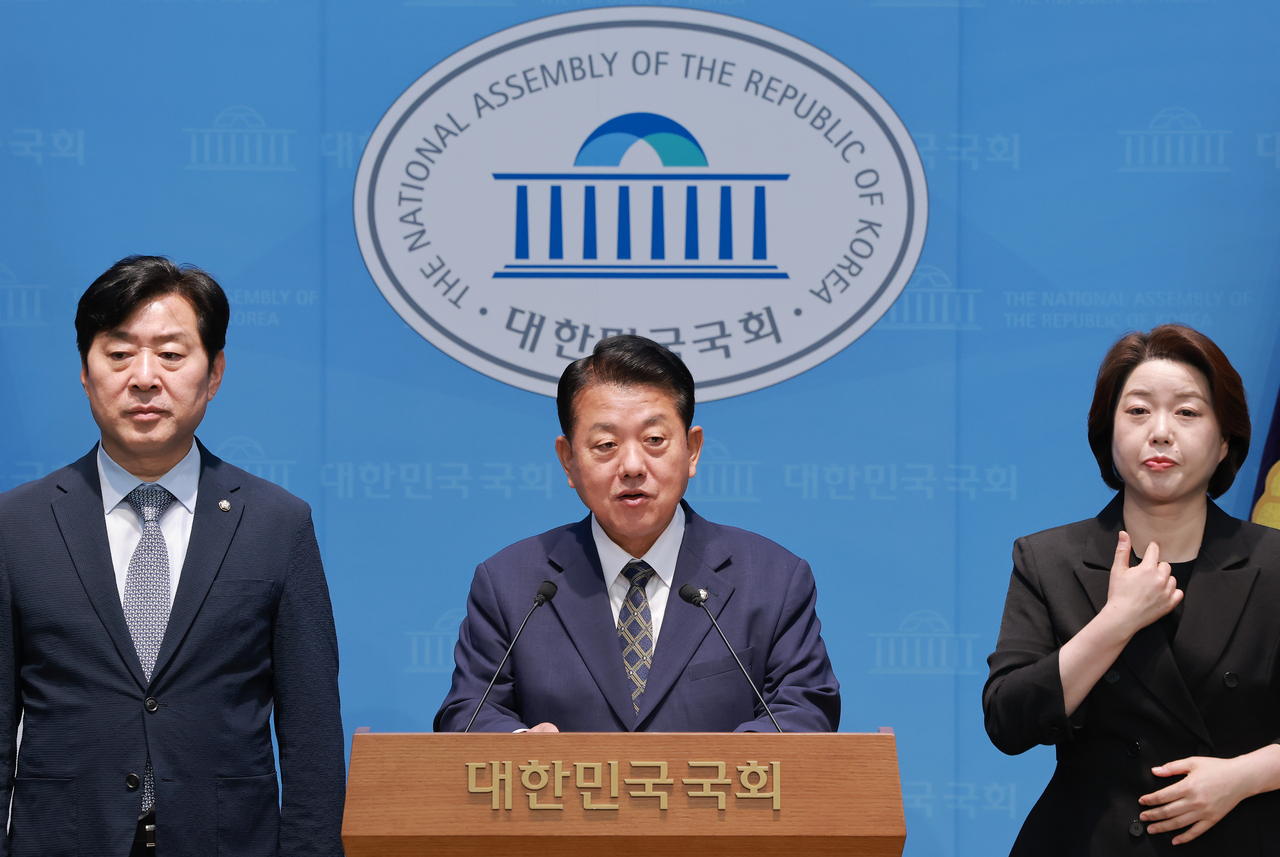
Rep. Kim Byung-joo of the ruling Democratic Party of Korea on Friday criticized South Korea's major defense companies for not spending enough on social contributions despite record earnings fueled by the country's defense export boom.
According to data submitted to Kim, a member of the National Assembly's National Defense Committee, by the Defense Acquisition Program Administration, the state arms procurement agency, the combined operating profit of five major defense companies — Hanwha Aerospace, Hyundai Rotem, LIG Defense & Aerospace, Korea Aerospace Industries and Poongsan — reached 2.69 trillion won (approximately $2 billion) in 2024.
Their combined spending on social contribution programs, however, stood at 17.32 billion won, equivalent to just 0.64 percent of their operating profit, according to the data.
"The combined operating profit of the five defense companies grew 3.5-fold in 2024 compared with 2022, and given the robust business conditions they have enjoyed, they should also make greater efforts to contribute to society," Kim said.
The spending accounted for 0.09 percent of the five companies' combined revenue of 20.35 trillion won, below the 0.19 percent average among South Korea's major corporations in 2024, according to data compiled by the Federation of Korean Industries.
All five companies also saw the ratio of social contribution spending to operating profit decline from a year earlier.
Hanwha Aerospace, which posted the largest operating profit among the five in 2024, saw the ratio fall from 1.46 percent in 2023 to 0.95 percent in 2024.
Rail and defense manufacturer Hyundai Rotem's ratio dropped from 0.58 percent to 0.24 percent over the same period, while KAI's fell from 0.39 percent to 0.25 percent. Missile maker LIG Defense & Aerospace saw its ratio decline from 0.71 percent to 0.46 percent, while ammunition manufacturer Poongsan's edged down from 0.12 percent to 0.09 percent.
The five companies also carried out only four projects supporting communities hosting military units over the past five years, according to the data.
"The achievements of K-defense were made possible by the national defense budget, the government's export diplomacy and local communities that have lived alongside business sites and military facilities," Kim said.
He called on DAPA to expand companies' contributions to local communities beyond the bonus points offered in some export support programs and incorporate such contributions more broadly into the designation and evaluation of defense contractors.
flylikekite@heraldcorp.com